Solution Patterns
Solutions developers combine platform primitives with domain-specific content and existing tools to deliver focused capabilities. The following patterns show how modeling, execution, data, and user interaction work together.
Automated Status Reporting
Keep stakeholders informed without manually assembling the same report every week. A scheduled Workflow retrieves issues, milestones, and recent updates from task-management software such as Jira. Juno summarizes progress, highlights blockers, and identifies missing or conflicting information, with links back to the source tasks.
Artifact Storage persists the normalized task data, source references, and generated report in a version-controlled JSON file artifact. A custom application hosted in App Sandbox consumes that JSON artifact to present project status, explain changes, and let stakeholders explore the supporting evidence.
The app saves report preferences and user annotations back to the JSON artifact as new versions, giving it persistent state within the platform's version-control model. Each reporting cycle preserves the inputs and summary used for that edition, so teams can compare reports and trace how project status changed over time.
Juno built this entire solution from user-provided requirements on the first try.
Satellite Trainer
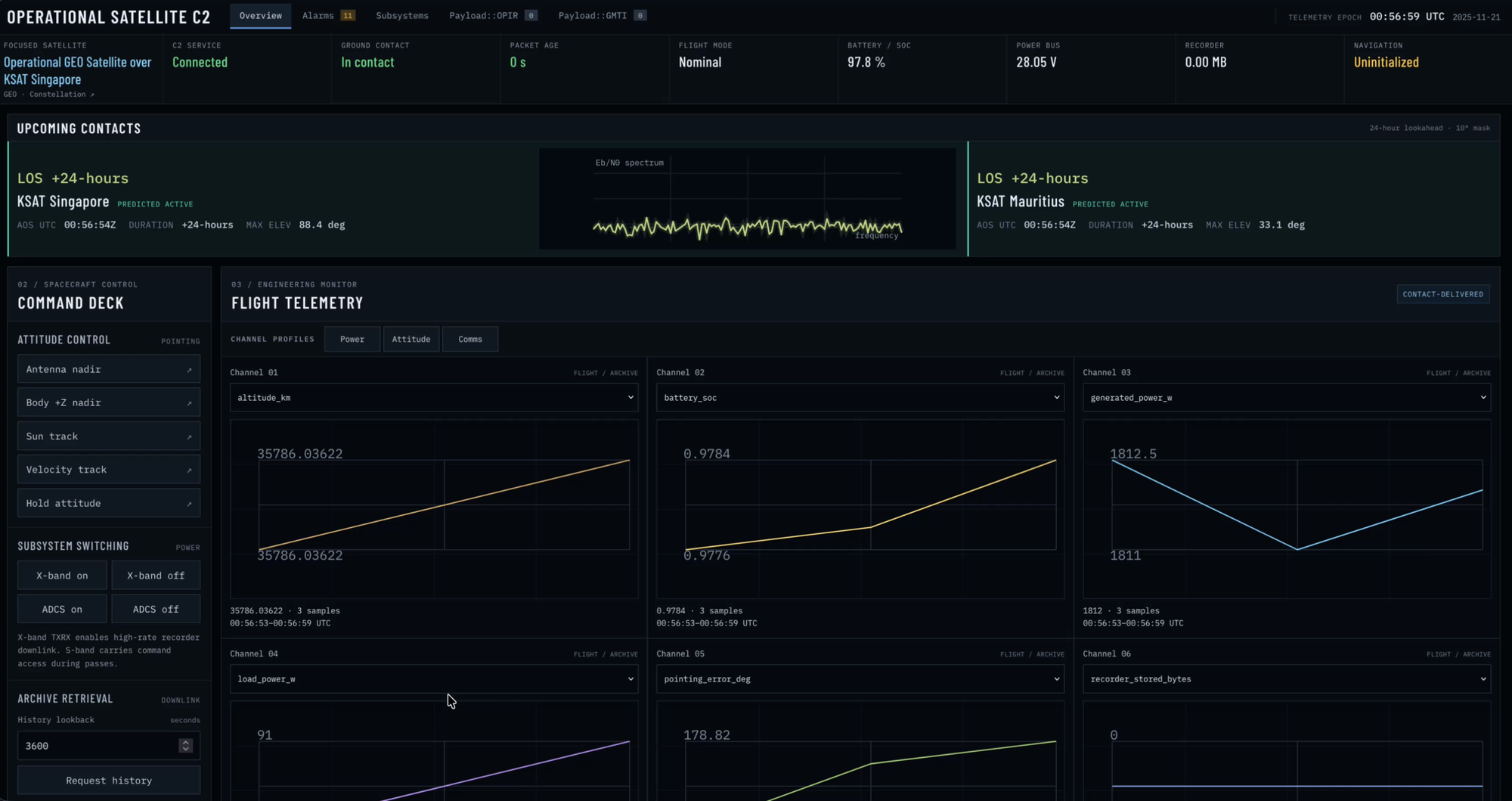
Create an interactive training environment for satellite operators and autonomy developers. Blueprint lets instructors configure missions and vehicle models from reusable thermal, power, guidance and control, command and control, and communications content. The Simulator executes those models, with systems entering or leaving a scenario and faults introduced to exercise operator responses.
Workflows launch and coordinate training sessions, while App Sandbox hosts the custom trainee and instructor application with governed access to platform capabilities. Data Fabric carries live state and commands between participants, and Dashboards present system behavior for live instructor monitoring and after-action review.
Artifact Storage preserves scenarios and session results, and Juno helps produce after-action reports grounded in the recorded evidence. The same composition provides a virtual test range for vehicle and mission autonomy.
Battlespace Forecasting and Decision Support
Combine current observations with models of system motion and behavior to forecast how a situation may evolve. Data Fabric distributes measurements, commands, and analyses from live integrations. Blueprint supplies composable models of the participating systems, their relationships, and uncertain parameters.
Distributed Simulators project possible outcomes as systems and conditions change. Workflows coordinate large-scale studies and Monte Carlo trials to examine alternative actions, coordinated effects, and uncertainty. Typed data preserves units and reference frames across model coupling and data exchange; SedaroTS provides the underlying type system.
DevSecOps brings third-party analysis and battle-management software into the solution. Juno helps interrogate results, Dashboards present forecasts alongside observations, and Artifact Storage retains the inputs and outputs needed to trace an assessment to its assumptions.
SimDevOps
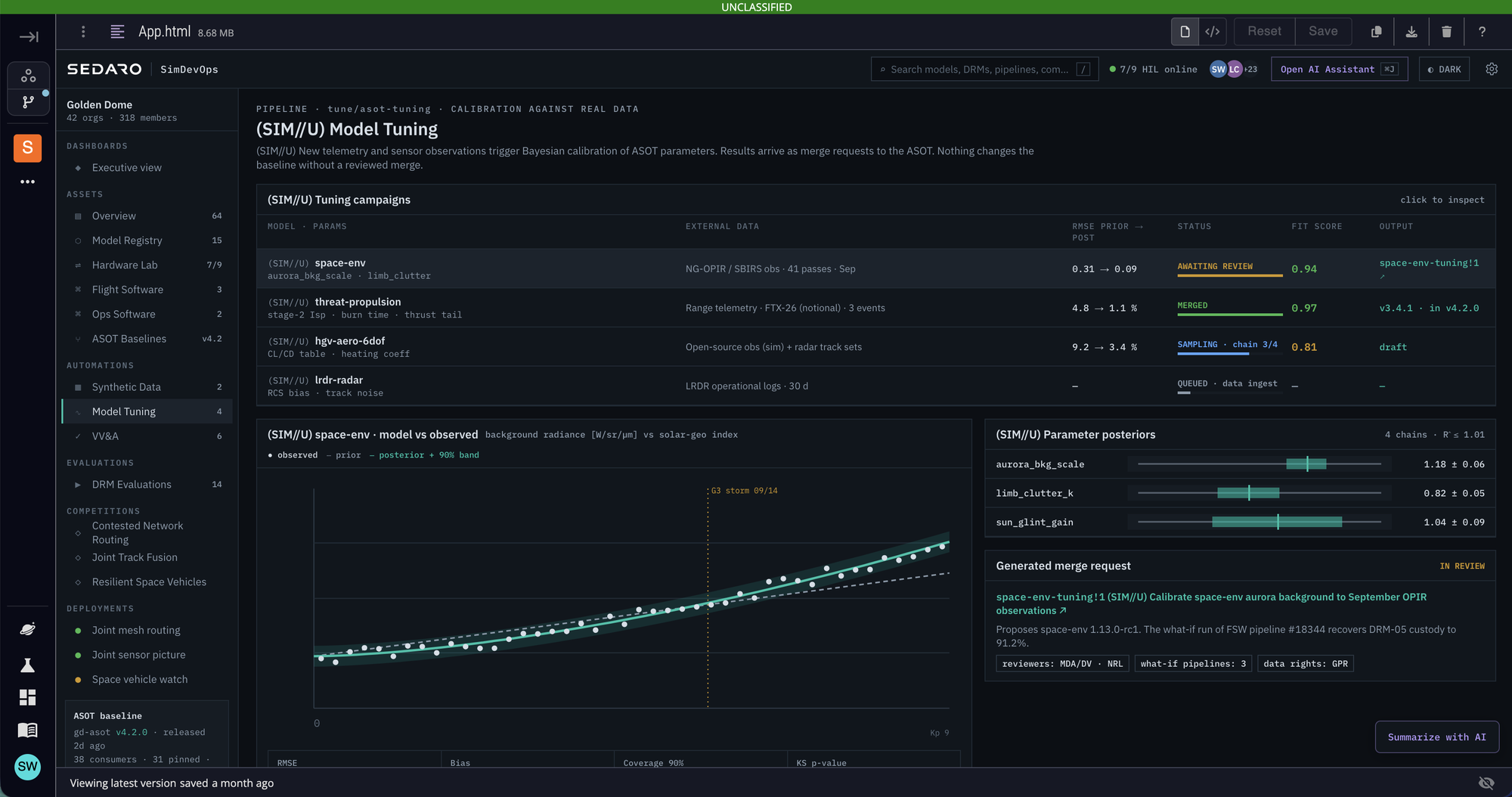
Apply continuous development, testing, and delivery to models and simulation-backed software. DevSecOps manages versioned code and deployment, while Blueprint and Artifact Storage organize models, reference data, and evidence under platform-native version control.
Workflows extend build and deployment pipelines with model tuning, verification, validation, and accreditation activities. They invoke Simulators and third-party tools, capture results, and compare candidate changes against an established baseline. Query-based model coupling selects data from the model's structure and relationships, reducing reliance on brittle field-by-field mappings as models evolve.
Juno assists with development and analysis. A custom application in App Sandbox brings pipeline controls, Dashboards, and supporting artifacts into one workspace. Teams can inspect the evidence, establish a new baseline, and deliver the resulting capability through the same governed development cycle.
Threat Intelligence Curation
Turn authorized intelligence sources into reviewed, versioned threat models and traceable analysis. Artifact Storage preserves source reports and existing authoritative models in their original formats, alongside the evidence supporting derived claims.
- A scheduled Workflow retrieves source artifacts, computes content hashes, and compares them with a processing ledger stored as a versioned JSON or YAML artifact.
- Juno processes new or changed material, aggregates related findings, and normalizes them into threat models editable in Blueprint. Updates retain source attribution and exact citations, portion-level classification markings, uncertain parameters, and the time periods to which claims apply.
- The workflow publishes proposed models, supporting evidence, and an updated ledger on a new platform-native version-control branch. Human reviewers inspect the changes and merge accepted updates into the authoritative baseline.
- Follow-on workflows use the reviewed threat models for authoritative analyses in AFSIM, publish updated Cameo model packages, and capture the results in Artifact Storage.
The cycle repeats as sources change. Authorized users can search and inspect the curated models and evidence through a custom application, tracing an assessment back to its sources, reviewed baseline, and analysis results.
Trusted Edge Autonomy
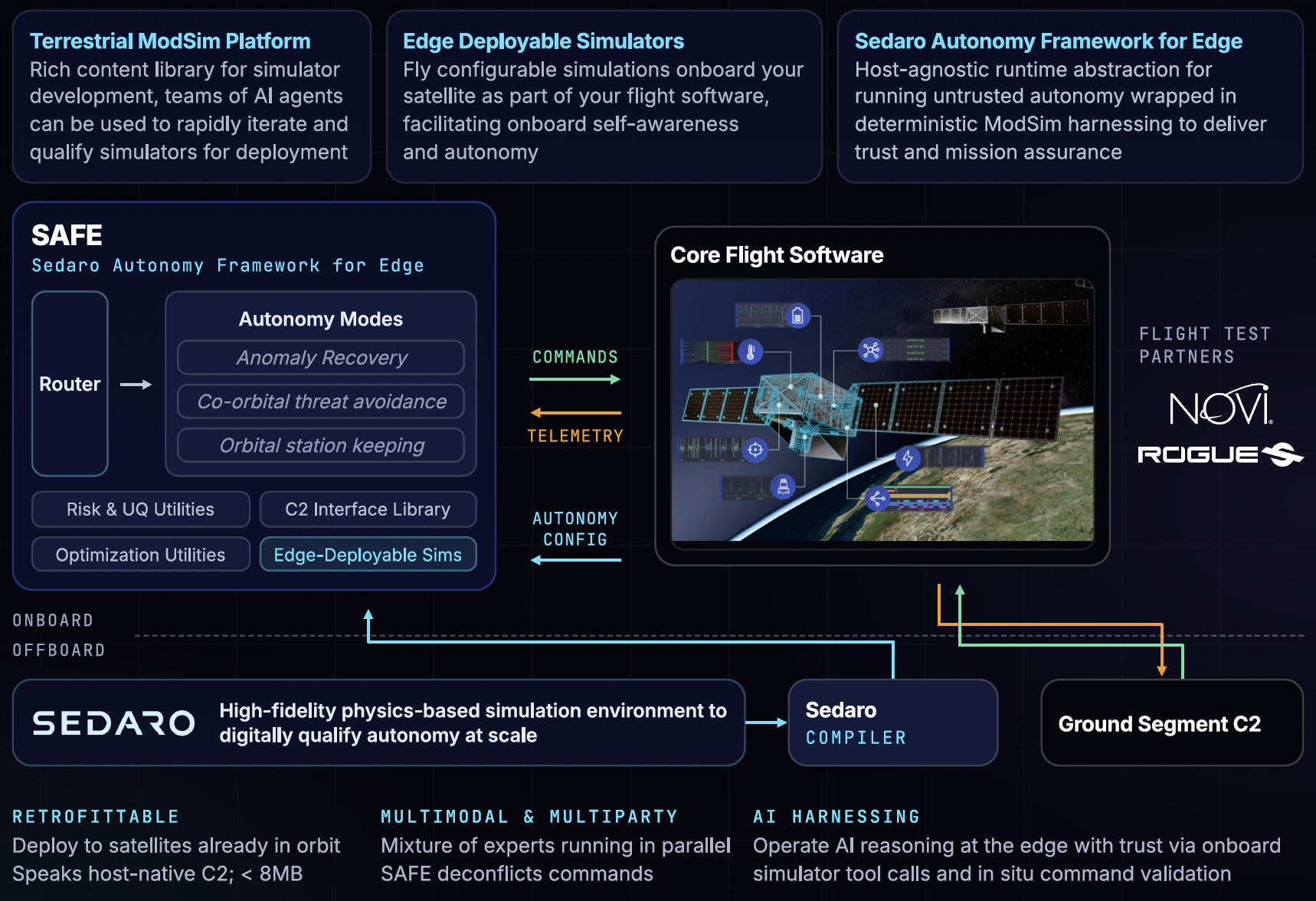
Develop and qualify autonomy in simulation before deploying it onboard. Blueprint defines vehicle, environment, and mission models, while ground-based Simulators provide a test environment for iterating on both model fidelity and autonomous decision-making. Teams of Juno agents can independently design and develop autonomy, exercise candidate implementations through Workflows, and gather evidence for verification, validation, and accreditation (VV&A).
Compile qualified models into edge-deployable simulators that run alongside onboard decision-makers. These simulators provide model-based self-awareness: estimating vehicle capabilities, forecasting the consequences of proposed actions, and evaluating decisions against operating constraints. A deterministic modeling and simulation harness, such as the Sedaro Autonomy Framework for Edge (SAFE), connects those predictions to command validation, moving simulation-backed decision support from ground operations onto the vehicle.
Operational Workflows use telemetry retained in Artifact Storage to compare observed and predicted behavior. Juno agents tune models, investigate discrepancies, and repeat qualification studies as conditions change. Artifact Storage preserves telemetry, model versions, and evaluation evidence, while DevSecOps delivers versioned updates to the edge. This closes the loop between operational experience, improved models, and trusted onboard autonomy.