Platform Primitives
Sedaro's primitives are focused building blocks for solutions developers. Each provides a distinct capability that can be used independently or combined with others to build purpose-built applications. You choose the models, tools, application logic, and interfaces; the platform provides shared infrastructure for execution, storage, collaboration, and secure delivery.
Open standards and APIs let you bring existing software and data into these applications and build new capabilities alongside them. Primitives share the platform's access controls, version control, and secure deployment infrastructure, so applications inherit a common foundation for trust and governance.
Blueprint
Build structured models of systems, their relationships, and their behavior through an approachable modeling interface. Blueprint makes domain models usable by people who are not subject-matter experts, with schema-informed fields, types, units, and relationships that guide model construction.
Capture classification markings and source attribution alongside model content, and define uncertain parameters as distributions rather than hiding uncertainty in separate analysis scripts. Models remain reusable, version-controlled content that can drive executable analysis, connecting system descriptions to predictions of how those systems behave.
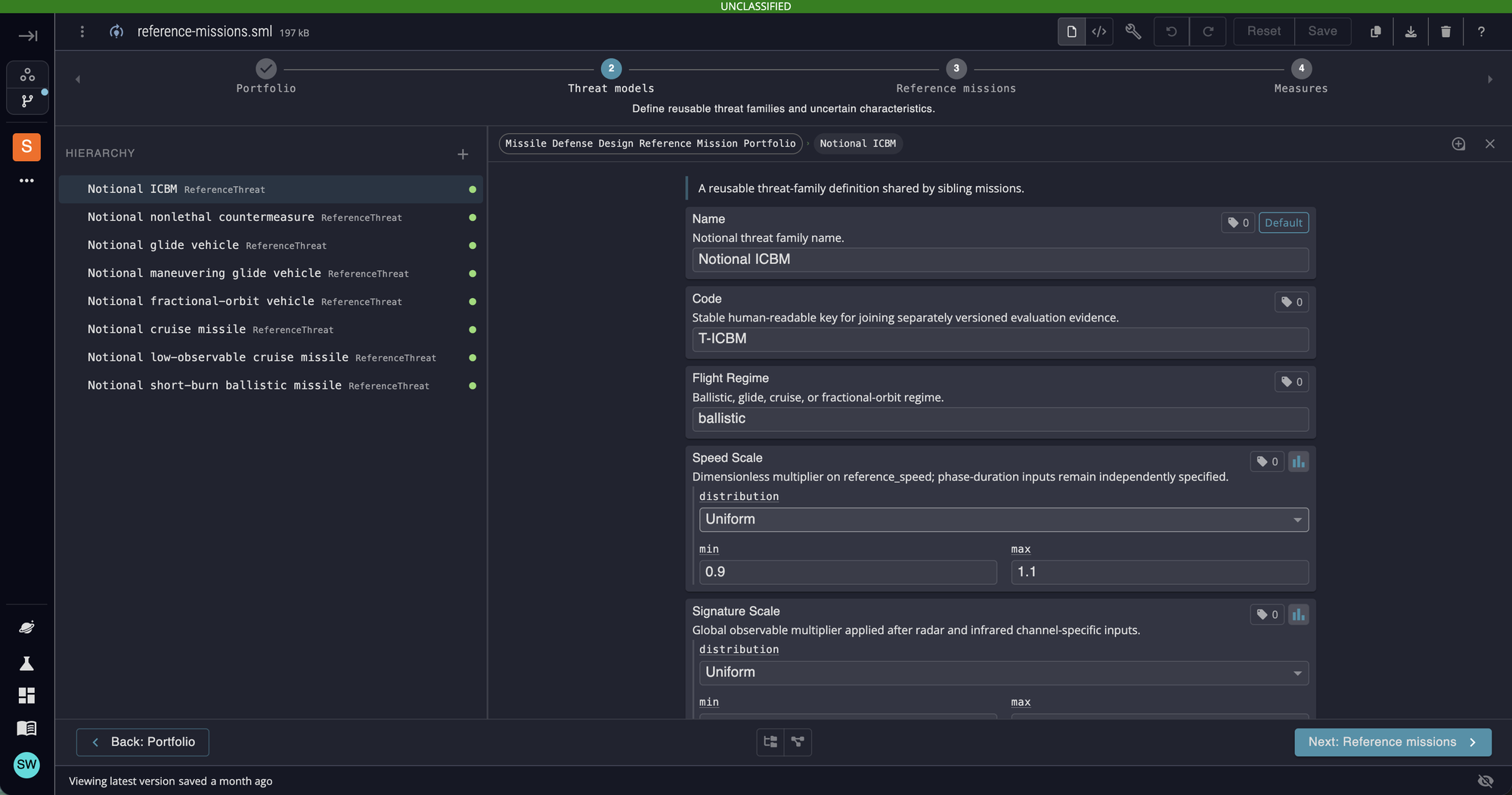
Learn about the underlying modeling language and uncertainty.
Dashboards
Build browser-based views of data and results using configurable visualization widgets. Combine charts, summary metrics, and spatial playback, with a shared clock that keeps time-dependent views synchronized. Dashboards are stored as content, so teams can version and reuse views alongside the data they present.
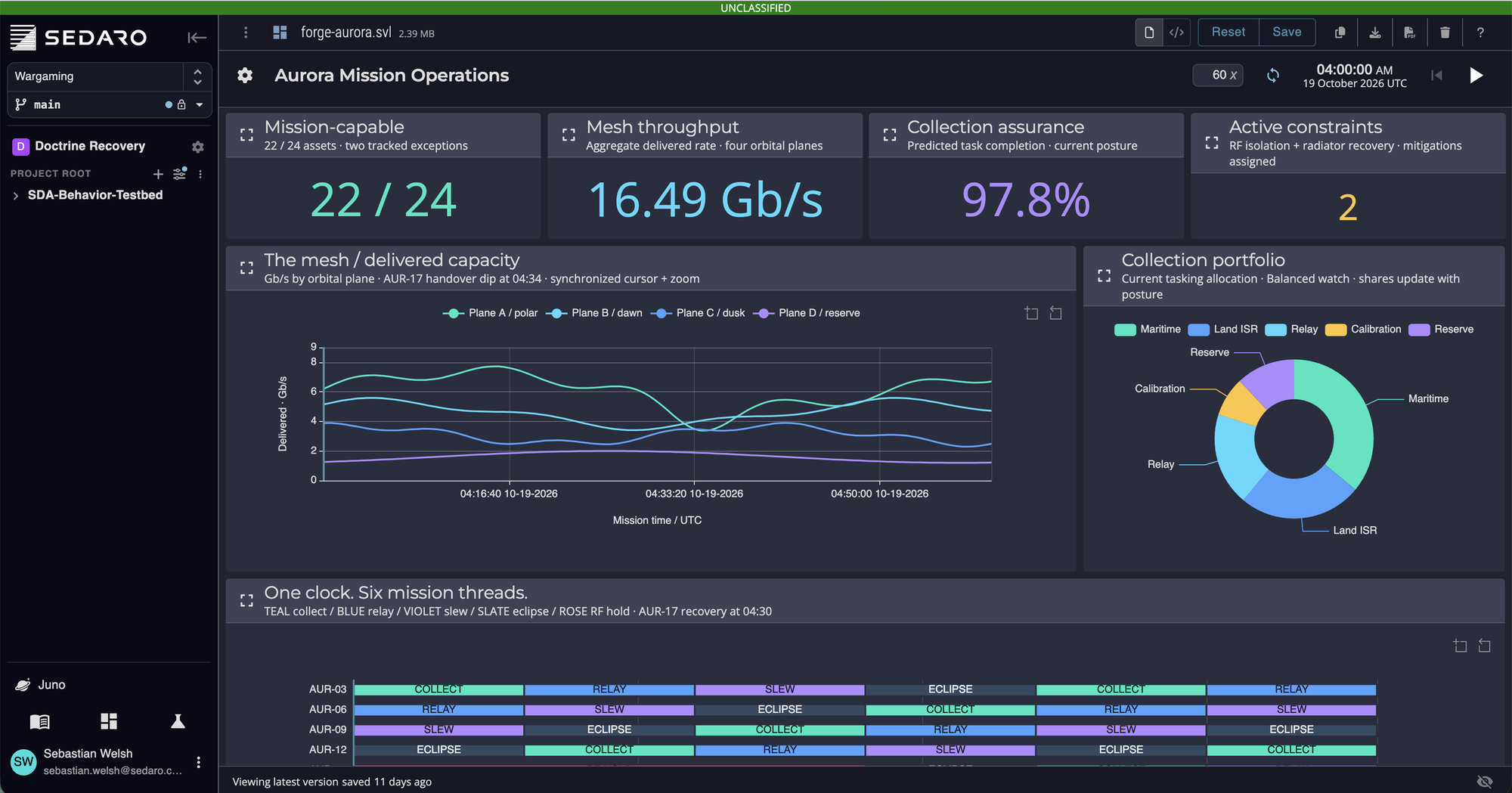
Learn how to define dashboards.
AI Agents (aka "Juno")
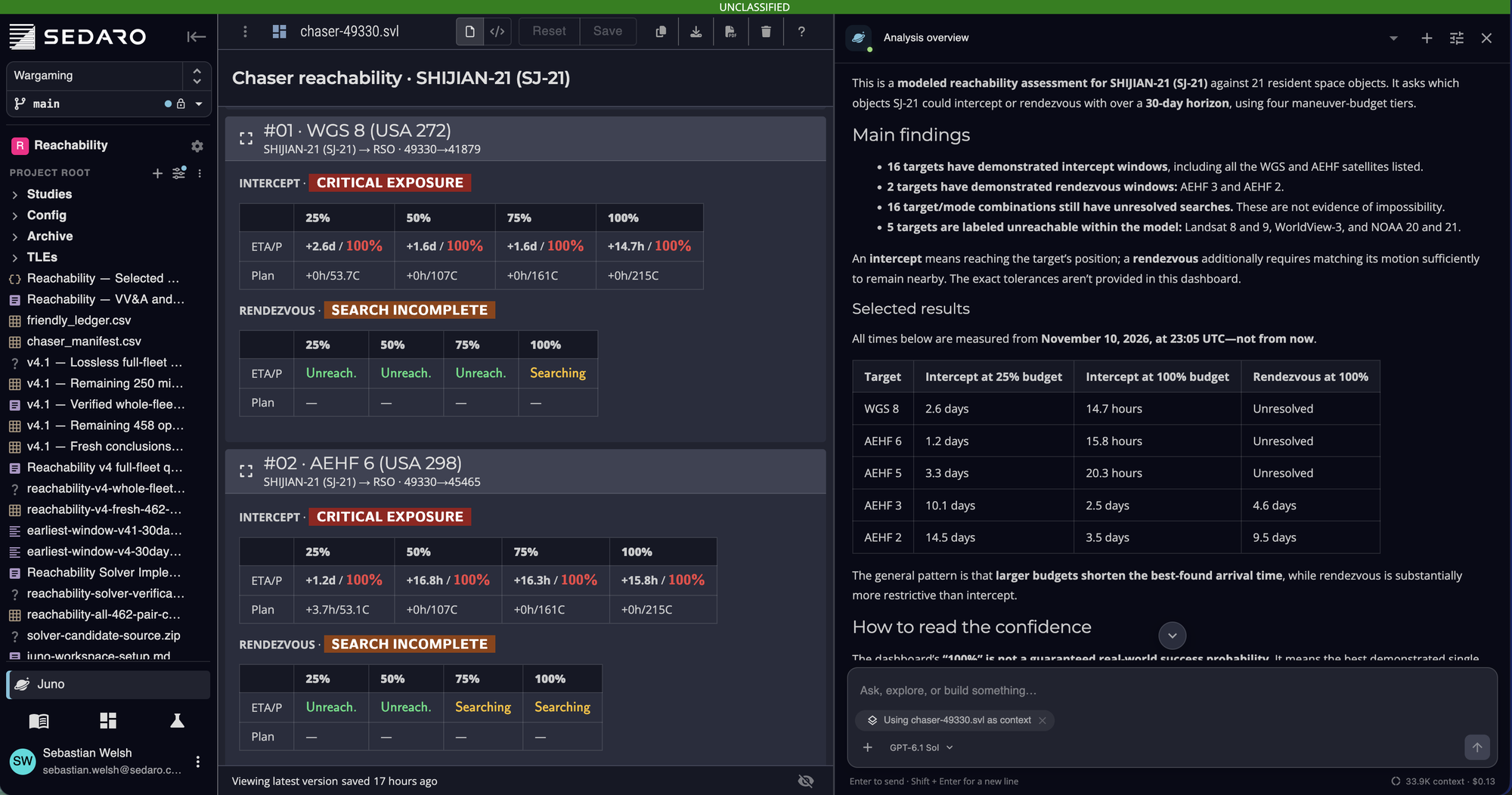
Delegate analysis, software development, and other multi-step work to independent AI agents. Juno can plan and complete work using platform capabilities and connected tools without requiring continual human input.
Use Juno through integrated chat or as a Workflow step, with frontier or sovereign models to suit the deployment's requirements. Agents act through the same platform capabilities available to users, within their assigned permissions.
Agents operate under full platform governance: their access is governed by scoped permissions, their content is versioned, and their execution is traceable. The platform supplies the trust foundation for autonomous work, allowing you to define what an agent can access and do while it independently carries out its assignment.
Artifact Storage
Store and version files, models, dashboards, and time-series datasets. Artifacts are organized within Projects and participate in Workspace branches and checkpoints. Teams can develop changes on isolated branches, compare revisions, and merge changes into shared baselines. Immutable versions and checkpoints preserve the history behind a baseline, supporting traceability and controlled evolution of the content used by applications and analyses.
Coming soon — Relational Data Artifacts: Store structured data in database tables scoped to Workspaces and Projects. These tables will be version-controlled artifacts, bringing relational data into the same collaboration, history, and baseline-governance model as other platform content.
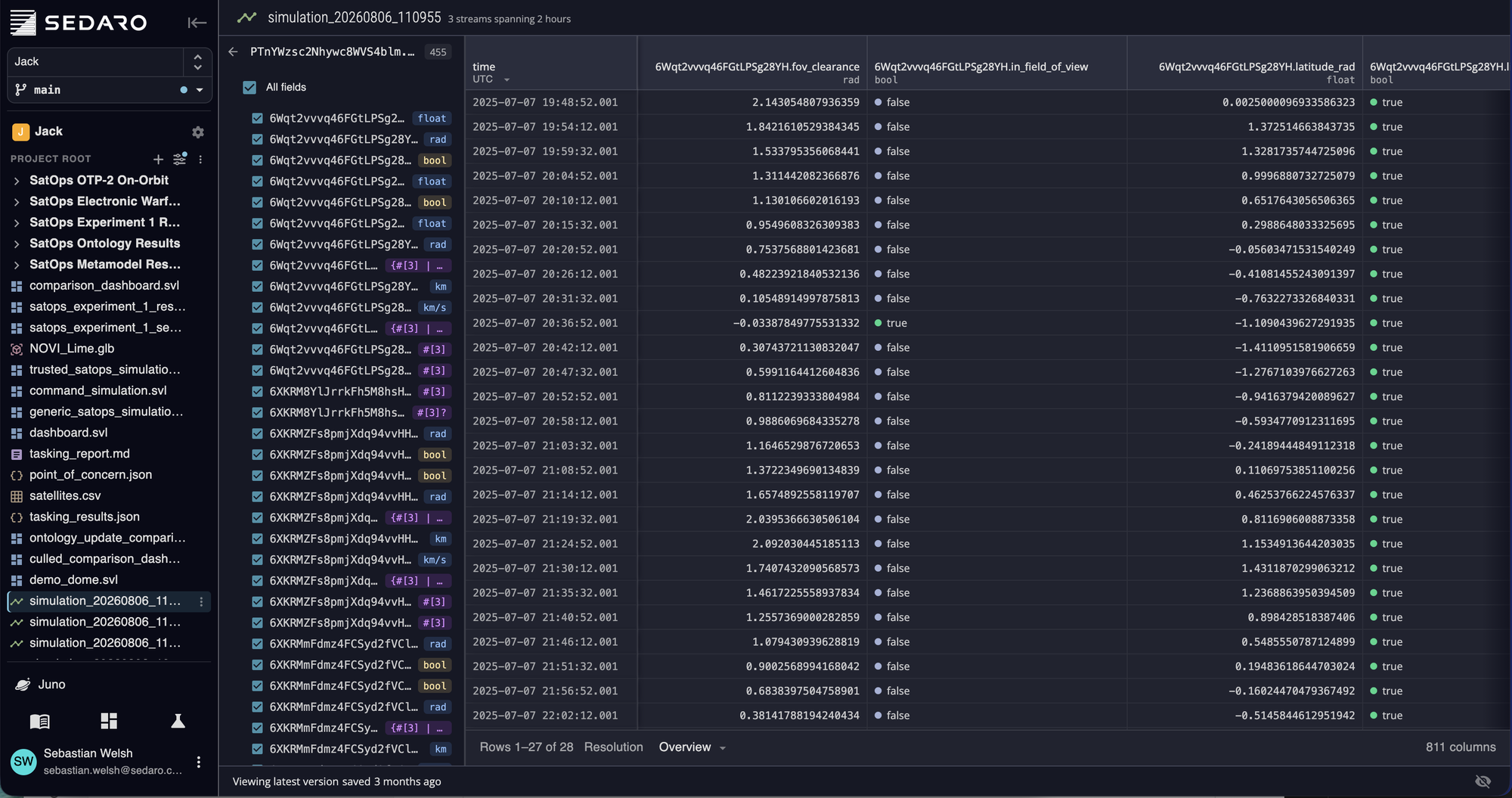
Learn about Artifact Storage and version control.
Workflows
Execute configurable, multi-step processes as containerized steps on Sedaro's hardened, scalable compute infrastructure. Orchestrate your code, third-party software, and one or many Juno agents and simulations as part of a workflow, combining autonomous tasks, computational analysis, and data processing. Steps can run in sequence or in parallel, with dependencies and outputs passed between them.
Start runs on demand, on a schedule, or in response to artifact changes. Each run records its configuration, resolved definition and code versions, status, logs, and outputs so teams can inspect what ran and how results were produced.
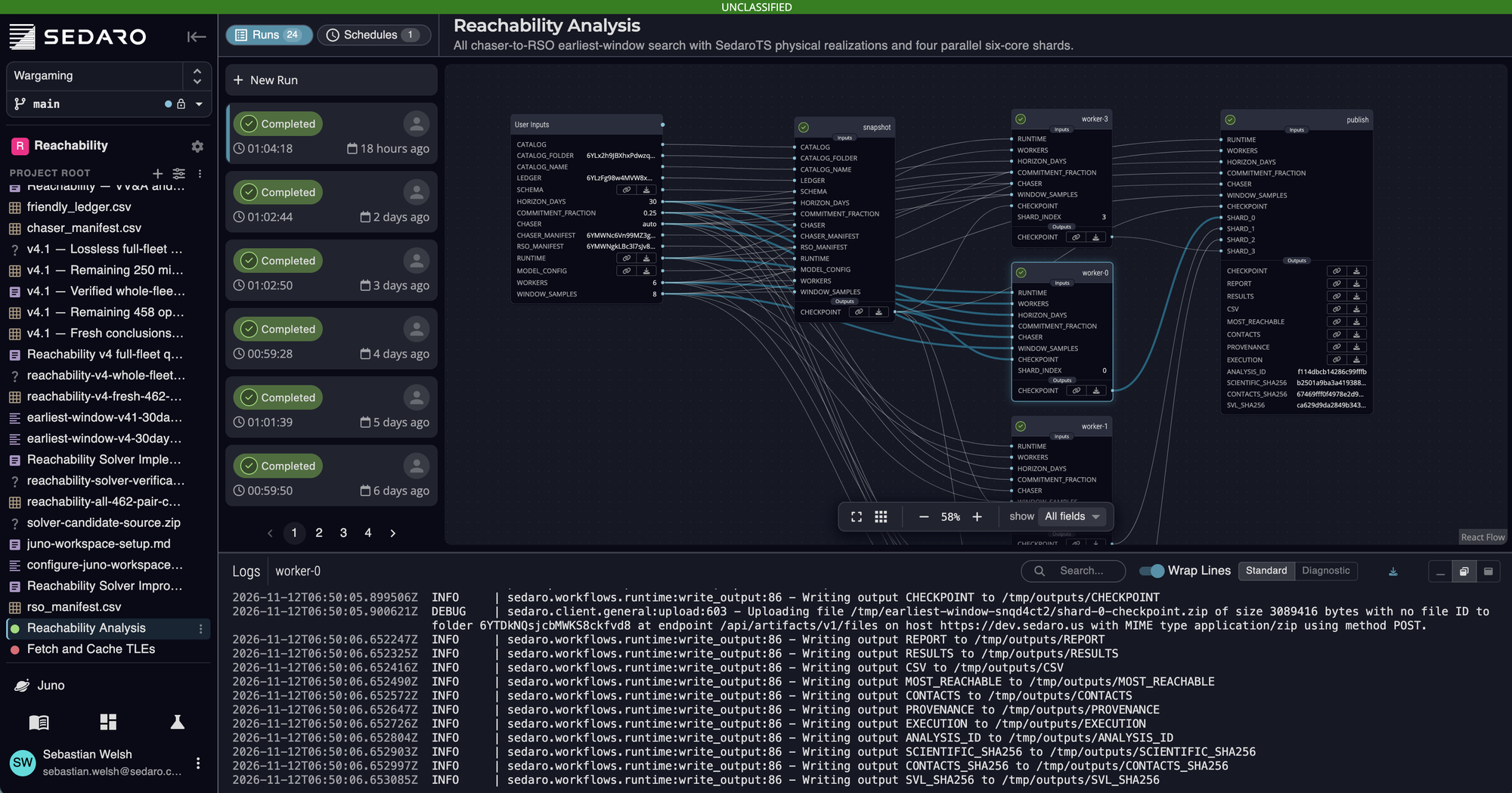
Explore Workflows or follow the quickstart.
App Sandbox
In beta.
Host custom applications built by humans or AI with safe execution and controlled access to platform data and capabilities. The sandbox applies platform permissions to application access, allowing teams to deliver purpose-built interfaces within the same trust and governance framework as the rest of their work.
Data Fabric
Connect live data producers and consumers through real-time publish/subscribe messaging, including external systems, applications, AI agents, and running simulators. Exchange ephemeral messages describing inventories, commands, observations, and analyses; use Artifact Storage when data needs to be persisted and versioned.
Support data exchange across multiple classification levels through authorized connections, with zero-trust access controls and post-quantum encryption protecting communications. Producers publish data for interested consumers while preserving the security boundaries around it.
Simulator
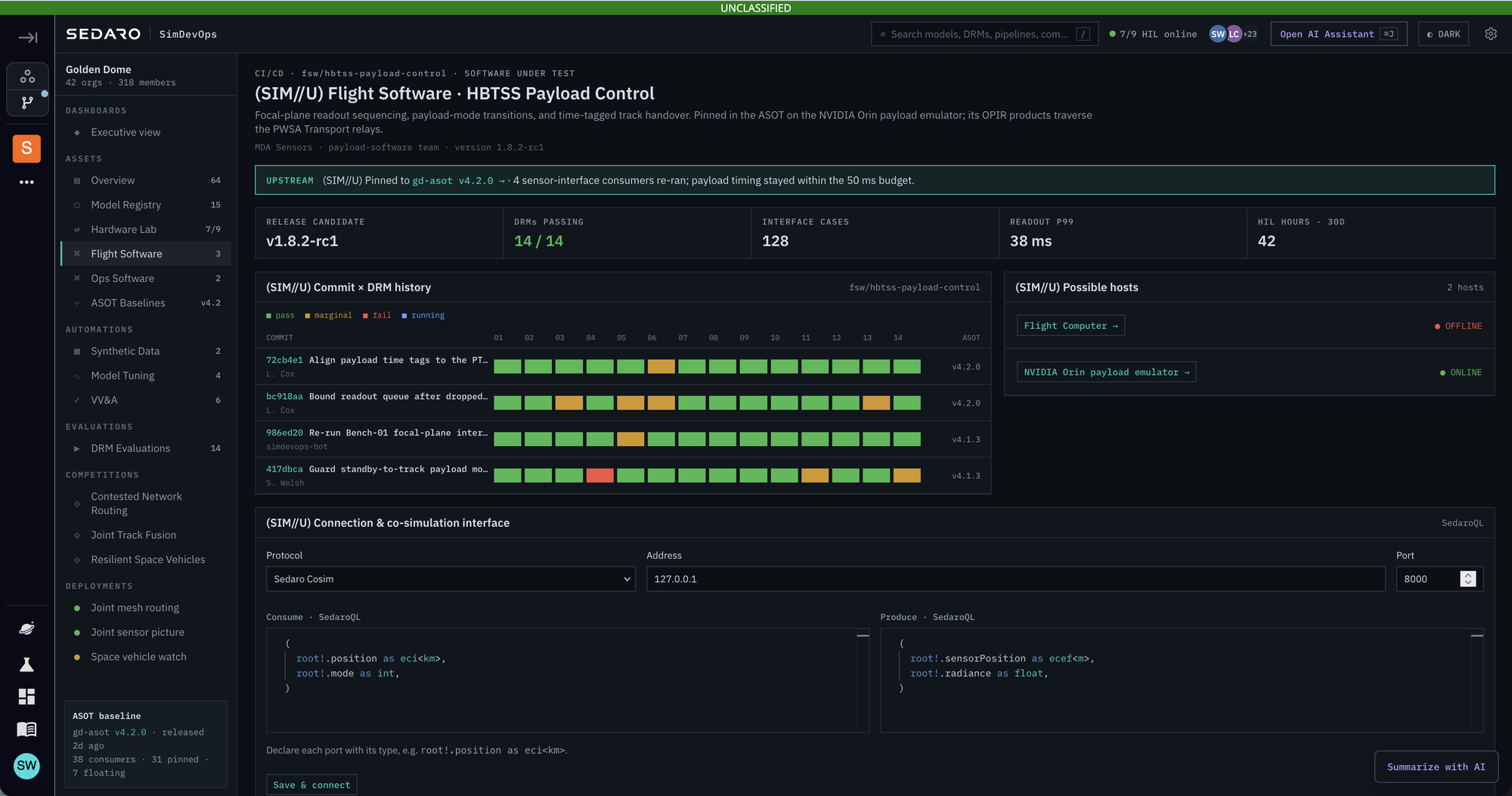
Turn composable models and computational behaviors into executable simulators, then run them on distributed cloud infrastructure or portable edge deployments. Compilation checks model consistency, types, and units and produces execution artifacts tailored to the target environment.
The runtime executes interacting systems over time, supporting real-time and faster-than-real-time operation. Co-simulation interfaces connect external software, hardware, and human participants to the running simulation. Reusable modeling content and custom computational logic can be combined without requiring every part of a system to use the same implementation.
Learn about compilation and execution, co-simulation, and edge deployment.
DevSecOps
Solutions developers can edit, version, and deploy code as platform content using Git and code-editing tools. Automated security analysis, hardened execution environments, and versioned deployment configuration support repeatable delivery across cloud, on-premises, air-gapped, and edge environments.
Learn about DevSecOps.
Access and Security
OpenID Connect (OIDC) establishes who is signed in and supports single sign-on through connected identity providers. OAuth 2.0 provides token-based authorization for applications acting on a user's behalf. Workspace and Project permissions determine which resources and actions an identity can access, within the platform's zero-trust security model.
Learn about identity and access control.
Explore Solution Patterns to see how these primitives combine into purpose-built capabilities.